
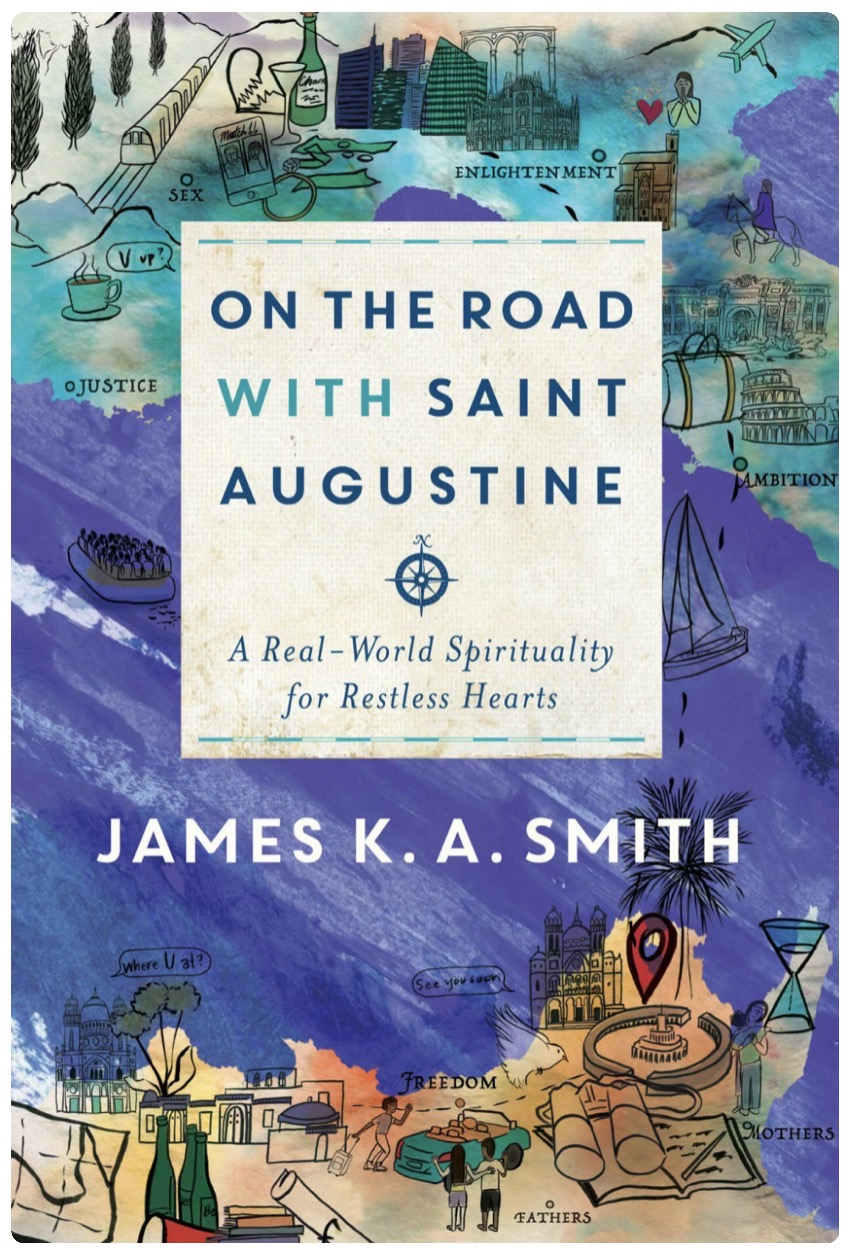
I am so encouraged by this book to reacquaint me, or acquaint me deeply for the first time to a great friend on a long journey. Smith, who is a philosopher by trade, was surprised at just how much St. Augustine’s life and thinking permeates our culture and thinking today. I could have put a link to all my Kindle highlights that I just re-read again today, but then you may have the entire book pasted in this blog post! Go get the book. I found myself riveted and at some points even welled up in tears and am also still thinking through many of these truths today about how to walk with our God.
Below are a few of my top quotes I have read and re-read a number of times now. We are longing for home, a true home we have joy in today though we have yet to arrive. Our Maker’s presence as he goes with his followers, is the home we have been tirelessly searching for.
E
We long for real home.
Do we tell ourselves we’re “just going” in order to guard against the disappointment of never arriving? Do we call the road “home” to avoid the pain of never being welcomed?
One’s own heart can be foreign territory, a terra incognita, and this lack of at-home-ness with oneself generates our propensity to run. We still can’t find what we’re looking for because we don’t know what we want. If we never seem to arrive, growing tired of every place that promised to be the end of the road, it’s because the terrain of our interior life is a wilderness of wants. When we leave home looking for happiness, we’re in search of the self we never knew.
Where we rest is a matter of what and how we love. Our restlessness is a reflection of what we try to “enjoy” as an end in itself—what we look to as a place to land. The heart’s hunger is infinite, which is why it will ultimately be disappointed with anything merely finite.
There is joy in the journey precisely when we don’t try to make a home out of our car, so to speak. There is love on the road when we stop loving the road. There are myriad gifts along the way when we remember it’s a way. There is delight in the sojourn when we know where home is.
Conversion [when you become a follower of Christ with a new nature] doesn’t pluck you off the road; it just changes how you travel.
A refugee spirituality does not make false promises for the present. It is not a prosperity gospel of peace and joy in the present. It warns of the allure of imagining one could settle in and for the present. An émigré spirituality is honest about what is not granted to our generation, so to speak—what is not granted to the human condition in this vale of tears. Hope is found in a certain art of saying goodbye, but also in looking ahead to the day when Someone will greet us with, “Welcome home”—and knowing how to navigate in the meantime.
[The] theology of the Christian life [is] as one of migration, a quest for a home one has never seen. Joy is arriving at the home you’ve never been to.
The soul’s hunger for peace is a longing for a kind of rest from anxiety and frantic pursuits—it is to rest in God.
What we’re hoping for is a place where a sovereign Lord can assure us, “You’re safe here.”
For Augustine, so much of our restlessness and disappointment is the result of trying to convince ourselves that we’re already home. The alternative is not escapism; it is a refugee spirituality—unsettled yet hopeful, tenuous but searching, eager to find the hometown we’ve never been to.
Conversion is not an arrival at our final destination; it’s the acquisition of a compass.
Ambition: What do I love when I long for achievement? That is the Augustinian question.
What is the arc of a life whose aspiration is to be a friend of God?
Domination of others is always temporary; you can’t win forever (just ask Rocky). Attainment is a goddess who quickly turns a cold shoulder. To aspire to friendship with God, however, is an ambition for something you could never lose. It is to get attention from someone who sees you and knows you and will never stop loving you. In short, it’s the opposite of fickle human attention, which is temporal and temperamental. God’s attention is not predicated on your performance. You don’t have to catch God’s notice with your display. He’s not a father you have to shock in order to jar his attention away from the game, crying out, “Look at me! Look at me!” God’s attention is a place where you can find rest and where, “in the father’s lap,” as Augustine later puts it, you don’t have to be worried about getting attention from anyone else.20 You can rest.
Abandoning the office to avoid the temptation is its own sin of irresponsibility, a Jonah-like evasion of the call on one’s life.
Resting in the love of God doesn’t squelch ambition; it fuels it with a different fire. I don’t have to strive to get God to love me; rather, because God loves me unconditionally, I’m free to take risks and launch out into the deep. I’m released to aspire to use my gifts in gratitude, caught up in God’s mission for the sake of the world. When you’ve been found, you’re free to fail.
…recognize that the insatiability of my hunger isn’t a bug but a feature—a signal that I long for something infinite. Wanting more isn’t the problem; it’s where I keep looking for it.
When I stop looking to some facet of finite creation to feed a hunger for the infinite, I don’t have to reject or detest creation. To the contrary, in a sense I get it back as a gift, as something to be (small-e) enjoyed as a way to (big-E) Enjoy the Creator who made it. It’s when I stop over-expecting from creation that it becomes something I can hold with an open hand, lightly but gratefully.
Summary quote on Home:
The road is long enough to tempt you to believe this. It seems like there is no end in sight—that we can’t get the last thing, can’t even glimpse its end, can’t imagine rest. Despair is natural. Running faster won’t help. Crumpling into the middle of the road and giving up doesn’t really solve anything either. And telling yourself “the road is life” over and over and over again starts to ring as a hollow consolation. You can’t get there from here. But what if someone came to get you? You can’t get to that last thing, but what if it came to you? And what if that thing turned out to be a someone? And what if that someone not only knows where the end of the road is but promises to accompany you the rest of the way, to never leave you or forsake you until you arrive?

