
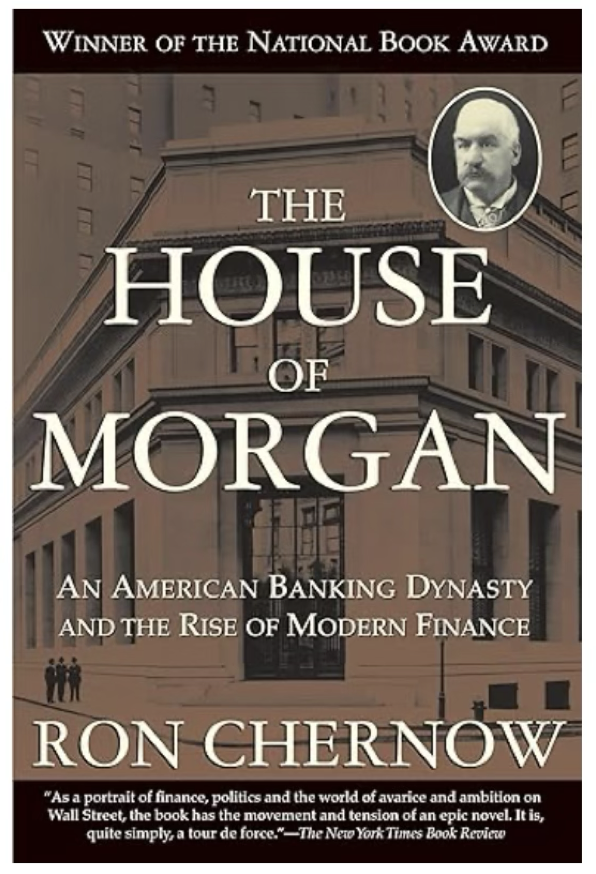
The House of Morgan: An American Banking Dynasty and the Rise of Modern Finance, by Ron Chernow
1. The central bank as we know it did not start until 1913. Before then banks even functioned as cash flow lenders for governments for war.
“The bankers acquired such power because many governments in wartime lacked the sophisticated tax machinery to sustain the fighting. Merchant banks functioned as their ersatz treasury departments or central banks before economic management was established as a government responsibility. The London banks didn’t lend their own funds but would organize large-scale bond issues.”
“The 1907 panic was Pierpont’s last hurrah. Although semiretired, reporting to work periodically for only an hour or two, he suddenly functioned as America’s central bank. Within two week’s time, he saved several trust companies and a leading brokerage house, bailed out New York City, and rescued the Stock Exchange. His victory was Pyrrhic, however, as America decided that never again would one man wield such power. The 1907 panic would be the last time that bankers loomed so much larger than regulators in a crisis. Afterward, the pendulum would swing decidedly toward government financial management.”
“Despite his venality, the gold operation had been a tour de force for Pierpont. He had functioned as America’s central bank, stepping into the historic breach between Andrew Jackson’s 1832 veto of the second Bank of the United States and passage of the Federal Reserve Act in 1913. So long as governments were financially weak, with primitive monetary methods and small budgets, they had to rely on private bankers.”
“The Pujo hearings had one immediate consequence that seemed to threaten Morgan power. In December 1913, President Wilson signed the Federal Reserve Act, providing the government with a central bank and freeing it of reliance on the House of Morgan in emergencies; the new Federal Reserve System was a hybrid institution, with private regional reserve banks and a public Federal Reserve Board in Washington. Yet the House of Morgan moved so artfully to form an alliance with the Federal Reserve Bank of New York that for the next twenty years it would actually gain power from the new financial system. The bankers had not yet been tamed.”
2. Morgan created and used voting trusts which turned bankers from lenders to directors.
“The following year, when the Erie went bankrupt, the irate bondholders shackled the road with a “voting trust” that would run the operation. It was a pivotal moment—the revenge of the creditors against the debtors, the bankers against the railwaymen. Later, in Pierpont’s hands, the simple device of the voting trust would convert Morgan into America’s most powerful man, placing much of the country’s railway system under his personal control. Through such trusts, he would convert financiers from servants to masters of their clients.”
“Pierpont and his partners, in turn, held 72 directorships in 112 corporations, spanning the worlds of finance, railroads, transportation, and public utilities. In this era of relationship banking, board seats often meant a monopoly on a company’s business.”
Brandies from Omaha broke this up: “Brandeis conducted a searching critique of the Gentleman Banker’s Code—those rituals that governed competition among elite banking houses. He sounded themes of excessive banker influence that would be amplified by the Pujo hearings and echoed in the New Deal, later shaping Securities and Exchange Commission policy. He argued for an arm’s-length distance between bankers and companies. For Brandeis, bankers who sat on corporate boards were in a conflict-of-interest situation. Far from being neutral confidants of companies, they were tempted to load up clients with unneeded bonds or charge them inflated commissions. The House of Morgan was his major object lesson; he said it symbolized “a monopolistic and predatory control over the financial and industrial resources of the country.”23 The Brandeis critique was predicated not on government regulation of monopolies but on breaking them up and reverting to a small-scale competitive economy. Over time, this view would prove far more threatening to the House of Morgan than the trust-busting of Teddy Roosevelt and other supporters of large-scale industry.”
3. Like Bob Van Kampen, Morgan hired for skill and talent not old money to build his base.
Pierpont selected partners not by wealth or to fortify the bank’s capital but based on brains and talent.
4. Voting trusts gave way to industrial trusts or holding company structures that gave rise to International Harvester where my grandfather worked for over 30 years.
Now, as the great merger wave gathered pace, the focus of elite Wall Street banks shifted from railroads to industrial trusts. In a trust, stockholders would trade their shares in constituent companies for the “trust certificates” of a super holding company. After enacting a law that permitted one company to own another, New Jersey became the preferred state for trust incorporation… For a $3-million fee, he merged the McCormick Harvesting Machine Company and the Deering Harvester Company plus three smaller companies into International Harvester. This new trust had an 85-percent share of the farm-equipment market. Perkins chose the name International Harvester because he foresaw the rise of global corporations and hoped the new trust would “comply with the laws of various countries and be at home everywhere.”
5. Being an international lender to Europe after WW1 had unintended consequences.
“In eloquent terms, he told Clarence Barron that the Allies shouldn’t strip Germany of hope by confiscating all its earnings through reparations… The $110-million New York portion was enthusiastically received and oversubscribed. By seeming to settle the German question, the loan lifted a weight from financial markets. It electrified Wall Street and spurred foreign lending to Latin America and elsewhere. For Weimar Germany, it was a turning point. It became the decade’s largest sovereign borrower. American capital and companies poured in: Ford, General Motors, E. I. Du Pont, General Electric, Standard Oil of New Jersey, and Dow Chemical. Unemployment plunged and Germany’s economic slide was reversed into a five-year upturn. This revival would provide Adolf Hitler with a splendid industrial machine and the money to finance massive rearmament.
6. With the 1929 crash, economic disaster struck far and wide. It was WWII that eventually got the United Stated out of the depression era recession. It was then that central banks for governments replaced large, private banks who did the work of the nations before WWII.
It was the Second World War—not the New Deal—that would wipe away the vestiges of the Depression… By World War II, banks were no longer large enough to bankroll wars, as Barings, Rothschilds, and Morgans had done in their heydays. With their large budgets, central banks, and taxing powers, the modern nation-states no longer needed to rely on the good offices of private bankers… After World War II, the Morgan bank was upstaged by a new set of multilateral institutions. Between the wars, the mysterious troika of the Bank of England, the New York Fed, and Morgans had largely governed the international monetary order. At Bretton Woods, New Hampshire, in 1944, they were superseded by a proposed World Bank and International Monetary Fund. These twin bodies would try to lift currency stabilization and European reconstruction to a supranational plane… The banker had grown powerful when capital markets were limited, with few financial intermediaries to tap them. In the post-World War II period, however, capital markets would burgeon and become globally integrated. At the same time, the financial field would grow crowded with commercial banks, investment banks, insurance companies, brokerage houses, foreign banks, government lending programs, multilateral organizations, and myriad other lenders. Gradually Wall Street bankers would lose their unique place in world finance. Never again would a private bank such as J. P. Morgan be the most powerful financial agency on earth.
7. The banking services that Pierpont oversaw now became split apart and made larger around the globe. The banking industry has exploded.
OVER fifty years later, J. P. Morgan and Company appeared to have erred in its choice of commercial banking in 1935. If it saved Depression-era jobs, it also burdened the House of Morgan with what proved to be a dying business—wholesale lending. Large companies no longer turned to banks for short-term credit or seasonal lending—activities now relegated to the commercial paper market. So Morgans had gradually undone its history and grown into a hybrid investment bank, much like its rival down the block, Bankers Trust.
The 1929 crash had led straight to Glass-Steagall. Ironically, the 1987 crash would prove its undoing, as Black Monday deepened national discontent with Wall Street. Morgan Stanley and the other big securities houses looked increasingly like a cosy cartel protected by Glass-Steagall —an outcome quite different from that expected by the New Deal reformers, who wanted to bust up concentrated Wall Street power. Meanwhile, commercial banks were the clear casualties of the 1980s. The Latin American debt crisis showed that lending was now far riskier than trading. The crisis mocked the spirit of Glass-Steagall, which had tried to guarantee the stability of deposit banks. With foreign banks able to underwrite securities in the United States, Glass-Steagall seemed only to penalize American banks and invite them to make rash decisions. With Japan now claiming seven of the world’s ten largest banks, this competitive disadvantage was no small matter.
The old House of Morgan’s power stemmed from the immature state of government treasuries, companies, and capital markets. It stood sentinel over capital markets that were relatively small and primitive. Today, money has become a commonplace commodity. A company in need of capital can turn to investment banks, commercial banks, or insurance companies; it can raise it through bank loans, bond issues, private placements, or commercial paper; it can draw upon many currencies, many countries, many markets. Money has lost its mystique, and banking, therefore, has lost a bit of its magic.
The Morgan story is the story of modern finance itself. A Pierpont Morgan exercised powers that today are dispersed among vast global banking conglomerates. The activities once performed by a knot of side-whiskered men in mahogany parlors are now spread across trading rooms around the world. We live in a larger, faster, more anonymous age. There will be more deals done and more fortunes made, but there will never be another barony like the House of Morgan.
 Blicks Blog