
A Burning in My Bones: The Authorized Biography of Eugene H. Peterson, Translator of The Message
Winn Collier
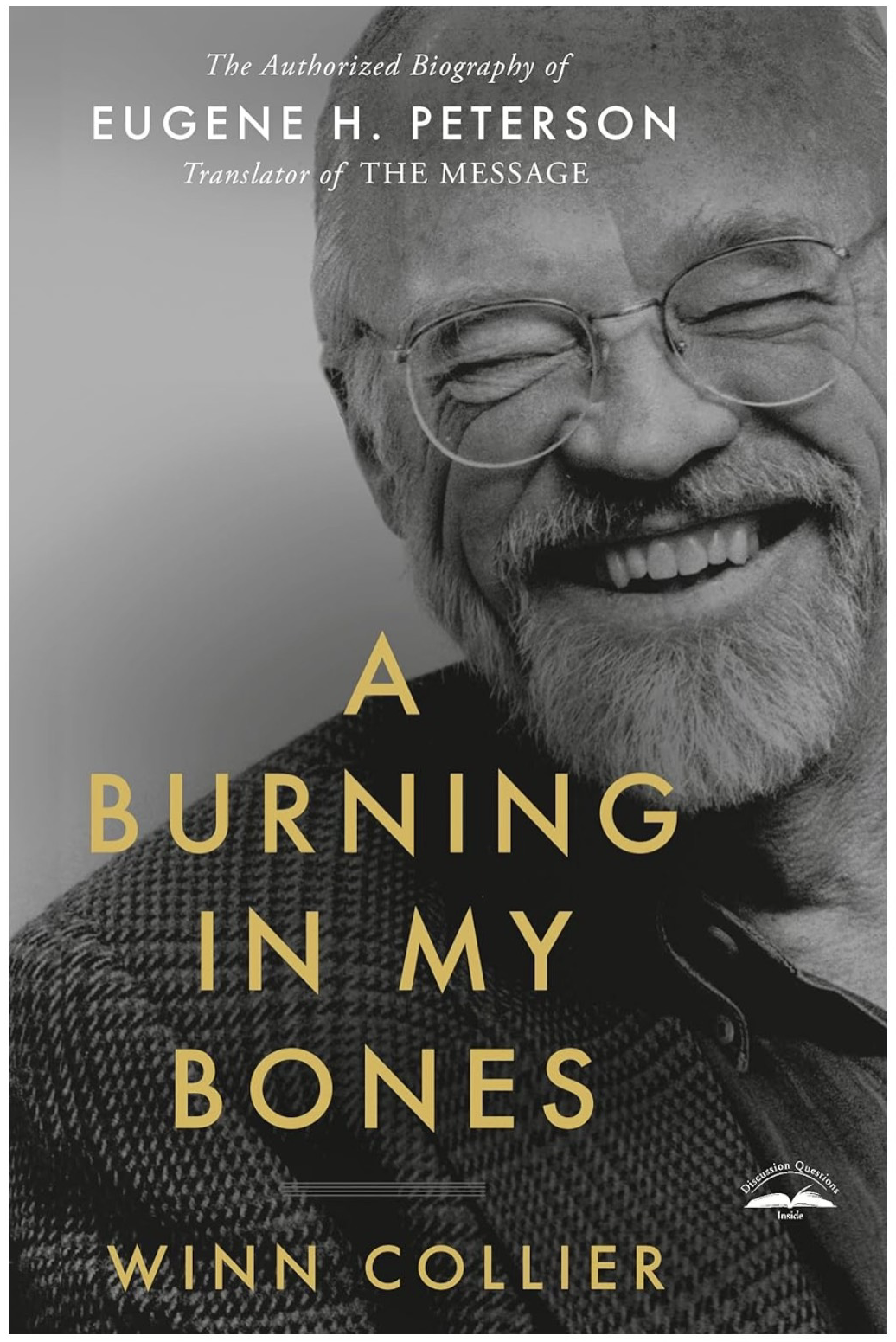
Here are four reflections that stood out to me after reading and thinking about the life of Eugene Petersen:
1.Eugene demonstrated the heart of a shepherd as he faithfully and passionately led his small church. He had deep affection to see people be healed through worship of the Living God. He found out he had the heart of a pastor and not a true college professor which in that role he used it to still pastor students.
– In preparing to preach: Every week, he wrote three names on a three-by-five-inch card and propped it on his desk. He kept those people in his sights as he prayed and studied that week’s text. It was all very primal… “What’s the most important thing you do for your sermon preparation each week?” Without hesitation, Buttrick responded, For two hours every Tuesday and Thursday afternoon, I walk through the neighborhood and make home visits. There is no way that I can preach the gospel to these people if I don’t know how they are living, what they are thinking and talking about. Preaching is proclamation, God’s word revealed in Jesus, but only when it gets embedded in conversation, in a listening ear and responding tongue, does it become gospel.
– he did have to wrestle, coming to the realization that he was a pastor, not a therapist. “Those two years of Tuesdays…clarified what I was not: I was not primarily dealing with people as problems. I was…calling them to worship God.”
– At Vancouver Bible College he writes, “I don’t fit; I’m not a scholar; I feel that I’m going to be found out any minute….I’m a pastor here, not a professor. The more people sought after him, the more he feared for his soul. This insidious pedestal. The seduction of celebrity. I fear a huge discrepancy between who I am and who people think I am—the prominence, the applause—there is a depersonalizing aspect to it.”
2. The Bible was beauty for him. It was not a weapon but a love letter opening up the world more in the love of God for him. This ultimately caused him to translate the entire Bible into the Message Translation that we have today, one phrase at a time. A translation that we beloved by Bono of U2 and spawned an unlikely friendship with this “modern prophet” on the world stage.
– The Bible—as Eugene had known it—offered principles for moral living, artillery for theological skirmishes, and clichés providing therapeutic salve. His church had implicitly used it as a textbook or occasionally even a weapon, but no one had ever guided him into the wonder, beauty, and artistry of the ancient pages. It had been a thing to use, to master. Under Traina, he saw Scripture as a world to be entered.
– One of his students he was pastoring not lecturing to: “She signed up for her first office hour with Eugene. Surely the professor who had translated so much of the Bible could invigorate her Bible reading. But instead, after hearing her struggles, Eugene gently leaned over and took her Bible out of her hands, then placed it on the shelf. He looked over his stacks of books, as if he were working through rows in his garden. Eugene pulled down ten novels, including Dostoevsky, Kingsolver, and Eliot. “Come back and talk to me after you’ve read these,” he said. Julie left, books in her arms and holding a new thread of hope.”
– Reading Anne Tyler’s Pulitzer Prize–winning Breathing Lessons stoked the burning in his bones. I want to write a spirituality with the same literacy as she brings to fiction. Why is it so common that people think when they write about God and Bible and Spirit, they are somehow exempted from writing well?
– So Lucky Dear God, I want to be a writer to your glory—I want to shape sentences and words out of my soul, not just my mind….Fresh, alive, prayerful sentences. So The Message is true. I offer myself as [a] servant to this text—and accept the ascetic appropriate to it. Please, dear Lord, help me to be moderate and submissive to your yoke. And serve you and marriage/Jan in this way. —Eugene Peterson, journaled prayer
– Translation is both a science and an art. It drew upon every part of Eugene—scholar, poet, pastor, wordsmith. Grammar was not enough. The text had to breathe, to move from one way of being into a fresh one, and faithfully. It was relational. The goal was a fresh spiritual encounter, similar to what early listeners and readers would have experienced.
– “Eugene was helping us understand that we do theology by praying our theology—and by singing our theology.
3. His love for his wife Jan was transforming to his holiness, their marriage was an impactful teamwork for others, and in which he learned the hospitality of connecting to others through real words, words of beauty.
– Later, Jan remembered Gertrude as the woman who introduced her to the hospitality of unhurried conversation—the hospitality that became Jan’s lifelong gift to the world.
-“Church ministry isn’t Eugene’s ministry. It is Jan and Eugene’s ministry.” Eugene was the force, but Jan was the glue. People came alive when they encountered her hospitality and effervescent warmth. She wooed people’s stories out of them. And Jan poked holes in Eugene’s seriousness, loved to say outrageous things.
– Eugene felt a growing urge, a deep necessity, for his focus and hospitality to be directed toward Jan. “The greatest gift of these final years,” Eugene told me, “has been how I’ve been able to show Jan, in ways I realize I failed to do before, that she is the most important thing in the world to me.” Eugene called marriage his “school of holy love.”
– If I am ever to be a saint, it is a saint of the basics: love Jan, be faithful at my prayers, write well and abundantly, prepare to die.
4. Eugene used running to build his hope, find beauty, commune with God, and be still before Him.
– And running. After SPU, Eugene had boxed up his running shoes, but he felt that familiar ache for “the easy rhythms, the relaxed sense of being physically in touch with the earth under my feet, the texture of the weather, my body working almost effortlessly in long cross-country workouts.” But there was also a more therapeutically complicated reason for Eugene’s return to running: he possessed a competitive fire. Ambitious energy could be good, but as fuel for his life as a pastor, ambition wrecked his soul. Running—and eventually training for races—allowed him to burn that competitiveness. For years, Eugene came home in the late afternoons and ran five miles. He craved “the uninterrupted quiet, the metronomic repetitiveness, the sensual immersion in the fragrance of trees and flowering bushes and rain, the springiness of the soil on park trails, the Zen-like emptying of the mind that felt like a freedom to be simply present, not having to do or say anything.”
 Blicks Blog