
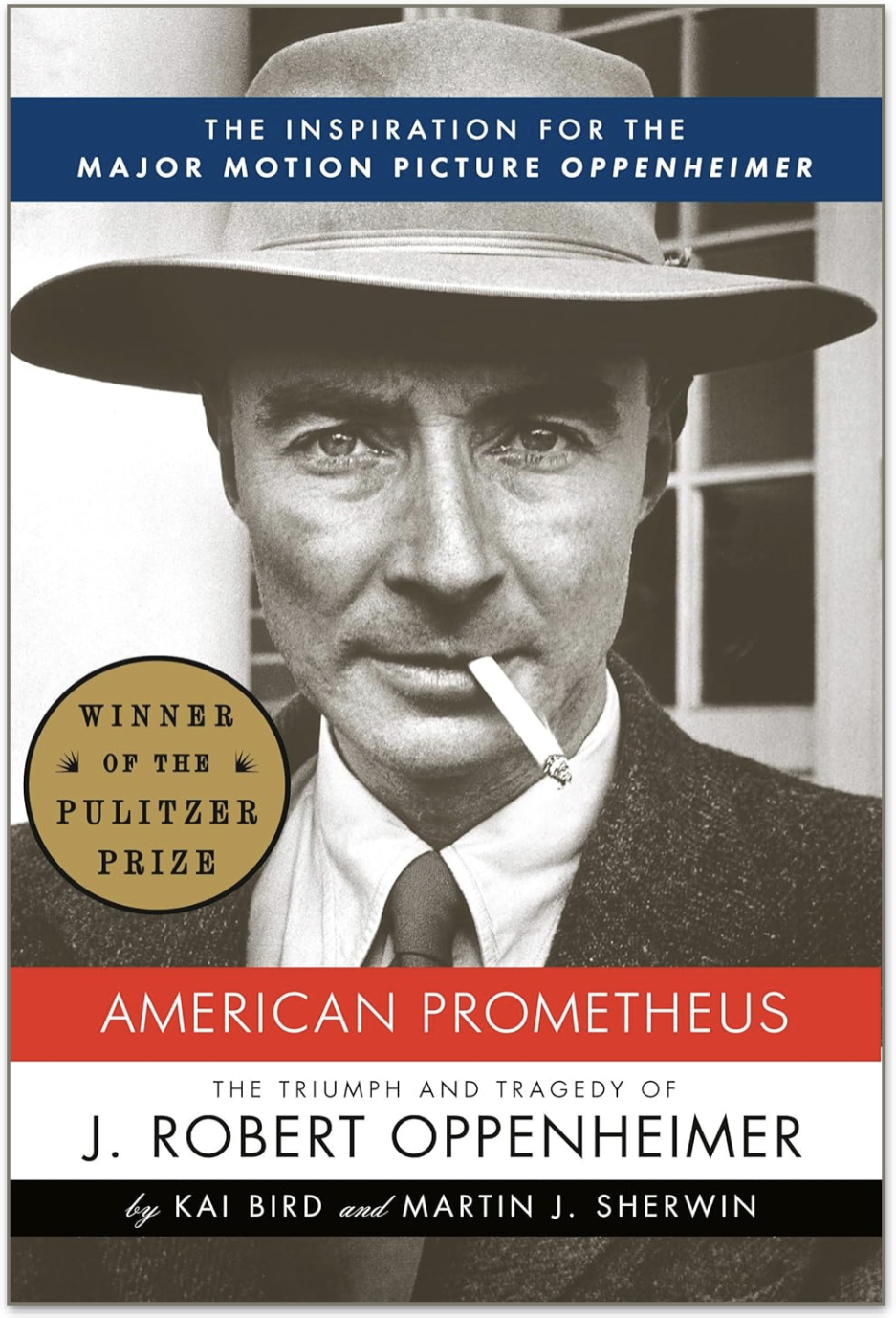
Five Reflections on Oppenheimer, American Prometheus.
There were many aspects of this story that connected to me. This was my family’s and grandfather’s world that he lived in and through, read all the newspaper articles, and watched all the newsreels, Milton bought 8mm film of some of these key news reels even without sound, was married to Theo in 1933, worked in downtown Chicago with the same white shirts, black rimmed glasses, full suits and overcoats and umbrellas and gloves and architectural designs and buildings, etc. He worked not far from where the Manhattan project was tested.
Milton Youngberg watched Pearl Harbor unfold live at the age of 31, and lived through Oppenheimers time, this Jew who’s family left Germany and who’s son wanted to lead in whatever way he could to help defeat the Nazi’s by beating the Germans in the race to figure out the atomic bomb, something never done before and hardly conceived by most. A good portion of this story took place in Berkeley, right down the street from my Uncle Bill & Aunt Barbara who were following all this at the time as well, being a Russian Jew husband and a wife from a German-fled family from Nuremberg, Germany in the 1930’s.
“By 1943, however, Oppenheimer had long since turned his back on union organizing. He did so not because he had changed his political views but because he had come to the realization that unless he followed Lawrence’s advice he would not be allowed to work on a project that he believed might be necessary to defeat Nazi Germany.”
This book was a slog, over 700 pages and hours on the Kindle, but worth it. Here are five reflections on the other side of finishing this book, revealing sections I easily loved, and including just a handful of the many quotable sections of this book. No wonder it won’t the Pulitzer Prize.
1. Letters and journals were an important way to think and process and relate and convey hospitality.
Phil Morrison could easily have been speaking for Oppenheimer when, late in 1945, he wrote Miss Warner a long letter of thanks for his many evenings in her company: “Not the smallest part of the life we came to lead, Miss Warner, was you. Evenings in your place by the river, by the table so neatly set, before the fireplaces so carefully contrived, gave us a little of your assurance, allowed us to belong, took us from the green temporary houses and the bulldozed roads. We shall not forget. . . . I am glad that at the foot of our canyons there is a house where the spirit of Bohr is so well understood.”
After the Trinity Test, “A few days later, Robert and Kitty went alone to Perro Caliente, [literally hot dog!] their cabin near Los Pinos, and spent a week trying to sort out the consequences of the incredibly intense last two years. It was the first time they had spent any real time alone in three years. Robert took the opportunity to catch up on some of his personal correspondence, replying to letters from old friends, many of whom had only recently learned from the newspapers what he had been doing during the war.”
2. Vocation can be exciting.
LOS ALAMOS WAS ALWAYS AN ANOMALY. Hardly anyone was over fifty, and the average age was a mere twenty-five. “We had no invalids, no in-laws, no unemployed, no idle rich and no poor,” wrote Bernice Brode in a memoir. Everyone’s driver’s license had numbers and no name; their address was simply P.O. Box 1663. Surrounded by barbed wire, on the inside Los Alamos was transforming itself into a self-contained community of scientists, sponsored and protected by the U.S. Army. Ruth Marshak recalled arriving at Los Alamos and feeling “as if we shut a great door behind us. The world I had known of friends and family would no longer be real to me”…
King Solomon wrote this and we have it as one of our TULIP verses which I love: Ecclesiastes 2:[24] There is nothing better for a person than that he should eat and drink and find enjoyment in his toil. This also, I saw, is from the hand of God, [25] for apart from him who can eat or who can have enjoyment?” In a letter to my son I wrote, “I love hard work and community together fulfilling the vocation that God has placed on your’s and my life.”
3. The slander and vindictiveness of McCarthyism was devastating in so many ways.
It was outside of due process in so many ways. The FBI was regularly doing many illegal wire taps and bugging. The AEC hearings were underhanded at many turns and outside the legal bounds of our justice system. Should he have listened to Einstein who advised him against testifying and participating in this Mickey Mouse trail of injustice? Einstein told him to just leave and avoid all this. ““Einstein doesn’t understand.” Einstein had fled his homeland as it was about to be overwhelmed by the Nazi contagion—and he refused ever again to set foot in Germany. But Oppenheimer could not turn his back on America. “He loved America,” Hobson later insisted. “And this love was as deep as his love of science.”
Proud of both his Jewish and his Southern heritage, Strauss pointedly insisted on pronouncing his last name as ‘Straws.’ Self-righteous to a fault, he remembered every slight—and meticulously recorded them in an endless stream, each entitled “memorandum to the file.” He was, as the Alsop brothers wrote, a man with a “desperate need to condescend.”
Oppenheimer was culpable in how he disagreed with Strauss. “Oppenheimer may not have set out to humiliate Strauss over what he regarded as a minor policy disagreement. But for Oppie, condescension came easily—too easily, many friends insisted; it was part of his classroom repertoire. “Robert could make grown men feel like schoolchildren,” said one friend. “He could make giants feel like cockroaches.” But Strauss was not a student; he was a powerful, thin-skinned, vengeful man easily humiliated.
So Strauss now took every opportunity to sow suspicion in Eisenhower’s mind about Oppenheimer.
Hoover authorized the [illegal] surveillance [that was inadmissible in court], and Strauss later learned that Oppenheimer had not been to the White House; instead, he had spent the entire afternoon in a bar in the Statler Hotel with the syndicated columnist Marquis Childs.
The Government of the United States is here on trial also.” In a veiled reference to McCarthyism, Garrison spoke of the “anxiety abroad in the country.” Anticommunist hysteria had so infected the Truman and Eisenhower administrations that the security apparatus was now behaving “like some monolithic kind of machine that will result in the destruction of men of great gifts. . . . America must not devour her own children.”
IN THE LONG RUN, however, Strauss’ strategy backfired; the transcript revealed the inquisitorial character of the hearing, and the corruption of justice during the McCarthy period. Within four years, the transcript would destroy the reputation and government career of Lewis Strauss.
Strauss was not confirmed ultimately because of this and the young John F Kennedy in congress being one of the key votes not to confirm Eisenhower’s choice of commerce secretary because of character. “Strauss’ enmity toward Oppenheimer had only deepened since the 1954 trial. And then all the old wounds had been reopened in 1959, when President Eisenhower nominated Strauss as his commerce secretary. In the bitter confirmation battle, in which the Oppenheimer hearing was a central factor, Strauss narrowly lost, by a vote of 49–46. Strauss correctly blamed Senator Clinton Anderson, and then Senator John F. Kennedy—who had been lobbied by Oppenheimer defenders like McGeorge Bundy and Arthur Schlesinger, Jr. When Kennedy protested, “It would require an extreme case to vote against the president,” Mac Bundy responded, “Well, this is an extreme case.” Bundy laid out for Kennedy Strauss’ reprehensible conduct in the Oppenheimer case. Convinced, Kennedy switched his vote and Strauss lost the confirmation.
4. A gifted teacher and collaborator, he could get the best out of people.
Even in high school, his teachers had noted his gift for explaining technical things in plain language. As a theorist who understood what the experimentalists were doing in the laboratory, he had that rare quality of being able to synthesize a great mass of information from disparate fields of research.
As Robert observed, Frank had a way of “reducing a specific and rather complex situation to its central irreducible Fragestellung [formulation of a question].”
OPPENHEIMER AT LOS ALAMOS,” Bethe said, “was very different from the Oppenheimer I had known. For one thing, the Oppenheimer before the war was somewhat hesitant, diffident. The Oppenheimer at Los Alamos was a decisive executive.”
Bethe remembered that Oppie “never dictated what should be done. He brought out the best in all of us, like a good host with his guests.” Robert Wilson felt similarly: “In his presence, I became more intelligent, more vocal, more intense, more prescient, more poetic myself.
5. Even before the bomb was complete, they contemplated the Cold War and actively advised presidents and generals of these future implications.
They arrived in Los Alamos late on the evening of December 30, 1943, and immediately went to a small reception in Bohr’s honor hosted by Oppenheimer. Groves complained later that “within five minutes after his [Bohr’s] arrival he was saying everything he promised not to say.” Bohr’s first question to Oppenheimer was, “Is it really big enough?” In other words, would the new weapon be so powerful as to make future wars inconceivable? Oppenheimer immediately understood the import of the question. For more than a year, he had concentrated his energies entirely on the administrative details related to setting up and running the new lab; but over the next few days and weeks, Bohr sharply focused Oppie’s mind on the bomb’s postwar consequences. “That is why I went to America,” Bohr later said. “They didn’t need my help in making the atom bomb.”
By the end of the decade, America’s stockpile of nuclear weapons would leap from some 300 warheads to nearly 18,000 nuclear weapons. Over the next five decades, the United States would produce more than 70,000 nuclear weapons and spend a staggering $5.5 trillion on nuclear weapons programs. In retrospect—and even at the time—it was clear that the H-bomb decision was a turning point in the Cold War’s spiraling arms race. Like Oppenheimer, Kennan was thoroughly “disgusted.” I. I. Rabi was outraged. “I never forgave Truman,” he said.
Oppenheimer’s argument was ““We do not operate well when they [important facts] are known, in secrecy and in fear, only to a few men.”
 Blicks Blog